Sovereign Stack
AI Gives Your Institution New Attack Surface Before It Gives You New Defenses
The Door That Opens Before the Lock Exists
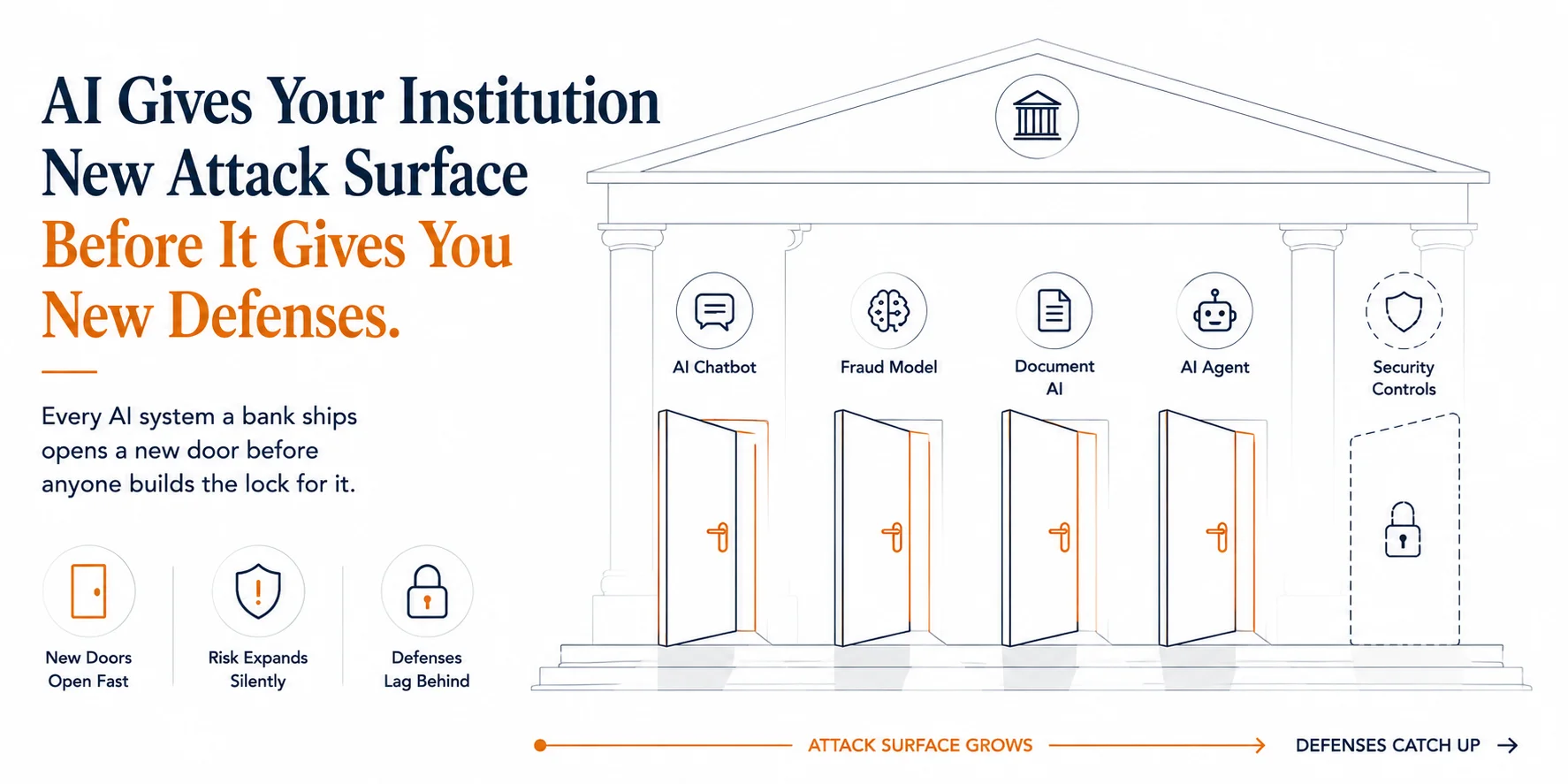
Here's something that keeps security teams up at night: every time the business ships a new AI feature, a new door opens into the institution before anyone has had time to build a lock for it. A customer-facing chatbot goes live and can be coaxed into revealing internal prompts. A fraud model gets deployed and someone downstream realizes its scoring logic can be reverse-engineered by probing it with enough test transactions. An agentic workflow gets wired into core banking to save an analyst a few clicks, and now it has more standing permissions than the analyst ever had.
And the faster the business ships AI features, the further ahead the exposed surface runs from the defenses built to cover it. And the further that gap runs, the more of the institution's actual risk posture is determined by what shipped last quarter rather than what security signed off on. Every AI system in production is a door. Very few of those doors were built with a lock as part of the original design.
AI is not a new application on top of your existing security perimeter. It is a new perimeter, and it arrives before the map of it does.
First, Let's Be Clear About What We're Talking About
This isn't the familiar cybersecurity conversation about patching servers and rotating credentials, though all of that still matters. AI attack surface is a distinct category, with its own failure modes:
- Prompt injection - an attacker embedding instructions in user input, a document, or a data source that hijacks a model's behavior
- Model extraction and inversion - an attacker querying a model enough times to reconstruct its logic, or worse, infer details about the data it was trained on
- Data poisoning - corrupting the data pipeline a model learns from, so the model itself becomes the vulnerability
- Over-permissioned agents - AI systems wired into core systems with more access than the task requires, because granting broad access was faster than scoping it precisely
The common thread is that none of these are addressed by traditional perimeter security. A well-patched, well-firewalled institution can still ship a model that leaks its own training data to anyone who asks the right sequence of questions.
Why This Gap Keeps Widening, Not Closing
Ship Velocity Has Outpaced Security Review Capacity. Product teams can integrate a new AI capability in weeks. Security teams that built their playbooks around annual penetration tests and quarterly reviews are structurally unable to keep pace, not because they're slow, but because the cadence assumption underneath their process no longer holds.
Vendors Expand the Surface Without Expanding the Institution's Visibility. A third-party AI tool embedded in a loan origination workflow or a customer support stack brings its own attack surface with it - one the institution didn't build, can't fully audit, and often doesn't know the shape of until an incident forces the question.
Agentic Systems Multiply Access Faster Than Access Reviews Can Track. An AI agent that can read a customer's account, call an internal API, and take an action on their behalf collapses three separate access grants into one system whose combined permissions rarely get reviewed as a single unit.
The Cost of Defending After the Fact
First, there's the discovery lag. Traditional intrusion detection is built to catch known attack patterns. Prompt injection and model manipulation often don't look like an attack at all - they look like an unusually well-crafted customer query, right up until the model does something it shouldn't have.
Second, there's the blast-radius problem. An over-permissioned agent that gets manipulated doesn't just leak information the way a compromised login might - it can take actions, and actions inside a core banking system are harder to undo than a data leak is to contain.
Third, there's the audit posture cost. A regulator or examiner asking "what's your AI attack surface, and how is it monitored" is asking a question most institutions can't yet answer with anything more concrete than a list of deployed models - not a map of what each one can reach, be manipulated by, or expose.
Closing Thought
The instinct to treat AI security as an extension of existing cybersecurity practice is understandable and wrong. The threat models are different, the failure modes are different, and the pace at which new surface gets created is different by an order of magnitude. Institutions that wait for AI-specific defenses to mature before they inventory their AI-specific exposure are choosing to fly blind for however long that maturity takes.
The institutions ahead of this aren't slowing down AI adoption to wait for security to catch up - they're mapping every model, agent, and integration's attack surface as it ships, so the gap between exposure and defense stays measured in days, not quarters. That's the layer Anvax builds for BFSI institutions: visibility into every door AI opens, the day it opens, not the day something walks through it.