Sovereign Stack
Your Customer Does Not Know They Were Denied by a Model
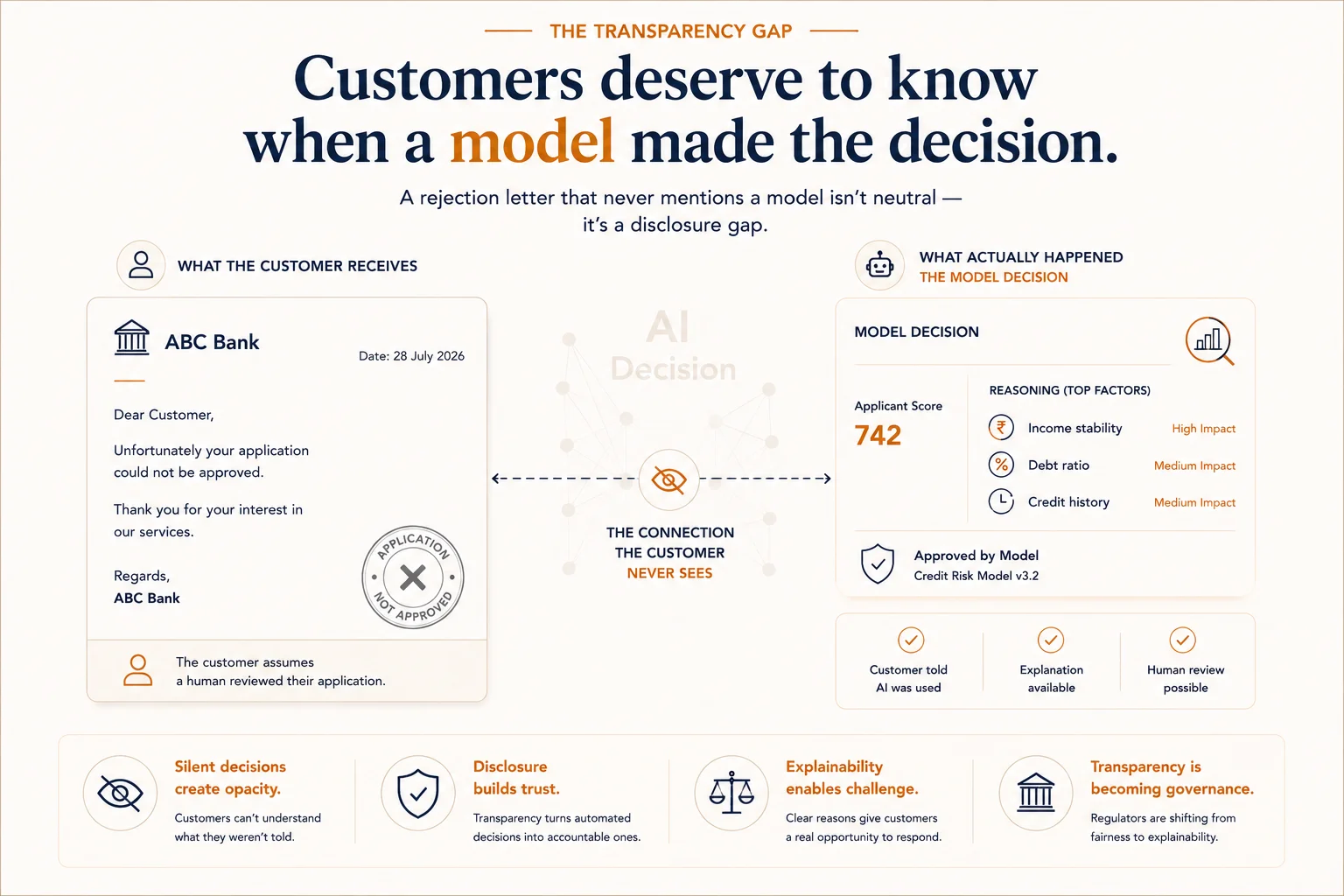
The Letter That Doesn't Mention the Model
Here's something that keeps customer-experience teams up at night: a customer applies for a loan, gets rejected, and receives a letter that reads like it was written by a person - polite, procedural, and completely silent about the fact that a model made the call in under a second. The customer assumes a human looked at their file. Nobody corrects that assumption, because nobody has to.
And the less a customer knows about how a decision was made, the less they can meaningfully contest it. And the less they can contest it, the more that silence starts to look less like an oversight and more like a design choice. A rejection letter that could have been written in 1995 is doing a lot of quiet work to make an algorithmic decision feel like a human one.
Your customer not knowing they were denied by a model is not a neutral gap in communication. It is a disclosure decision, made by default, that happens to benefit the institution more than the customer.
First, Let's Be Clear About What We're Talking About
This is not a debate about whether models should make credit decisions. Automated underwriting is faster, more consistent, and often fairer than manual review done under time pressure. That's not the issue.
The issue is narrower and more specific: whether the customer on the receiving end of an automated decision knows that it was automated, and whether they were given anything close to a real explanation. A defensible disclosure standard includes:
- A plain statement that the decision involved an automated system, not just a human reviewer
- The primary factors that drove the outcome, in language a customer can act on - not a model's internal feature names
- A real path to ask for human review, not a customer service number that reads from the same script the model used
Most institutions clear the strict legal minimum in whichever jurisdiction they operate. Very few clear the standard a customer would actually recognize as "I understand what happened to me."
Why This Gap Is Getting Harder to Defend
Regulators Are Moving From Fairness to Explainability. The conversation has shifted from "is the model biased" to "can the customer understand and contest the outcome." An institution that can prove statistical fairness but can't produce a customer-facing explanation is solving yesterday's question.
Silence Reads as Concealment Once Customers Notice. The first customer who realizes a decision was automated - through a viral post, a journalist, or a regulator's report - reframes every past rejection letter as something that was withheld from them, not just unstated.
Explainability Debt Compounds With Every Model Shipped. An institution that ships automated decisioning into five more products without building the explanation layer each time is accumulating a stack of decisions it cannot currently defend to the people they were made about.
The Cost of Leaving Customers in the Dark
First, there's the dispute-resolution cost. A customer who doesn't understand why they were denied can't provide the specific counter-evidence that would let a human reviewer overturn the decision - so disputes take longer, cost more, and resolve worse for everyone involved.
Second, there's the regulatory exposure. As explainability requirements sharpen, "we didn't disclose that it was automated" moves from a gray area to a plain gap, and gaps like that get found in exactly the review cycle an institution least wants them found in.
Third, there's the trust cost, which is the slowest to show up and the hardest to reverse. A customer who later learns they were declined by a model, without being told, doesn't just distrust that one decision - they start assuming every interaction with the institution has an undisclosed layer they weren't shown.
Closing Thought
Automated decisioning was always going to become the default in BFSI - the economics are too strong for it not to. The open question was never whether models would decide; it was whether institutions would tell the people affected. Treating that disclosure as optional was a defensible bet when nobody was asking. It stops being defensible the moment someone does.
The institutions getting ahead of this aren't slowing down automation - they're building the explanation layer alongside it, so every automated decision comes with a customer-legible reason and a real path to human review. That's the layer Anvax builds for BFSI institutions: not a rejection letter that hides the model, but a decision record that can be explained to the one person who actually needs to understand it.