Sovereign Stack
Model Governance Does Not End at Deployment.
That Is Where It Starts.
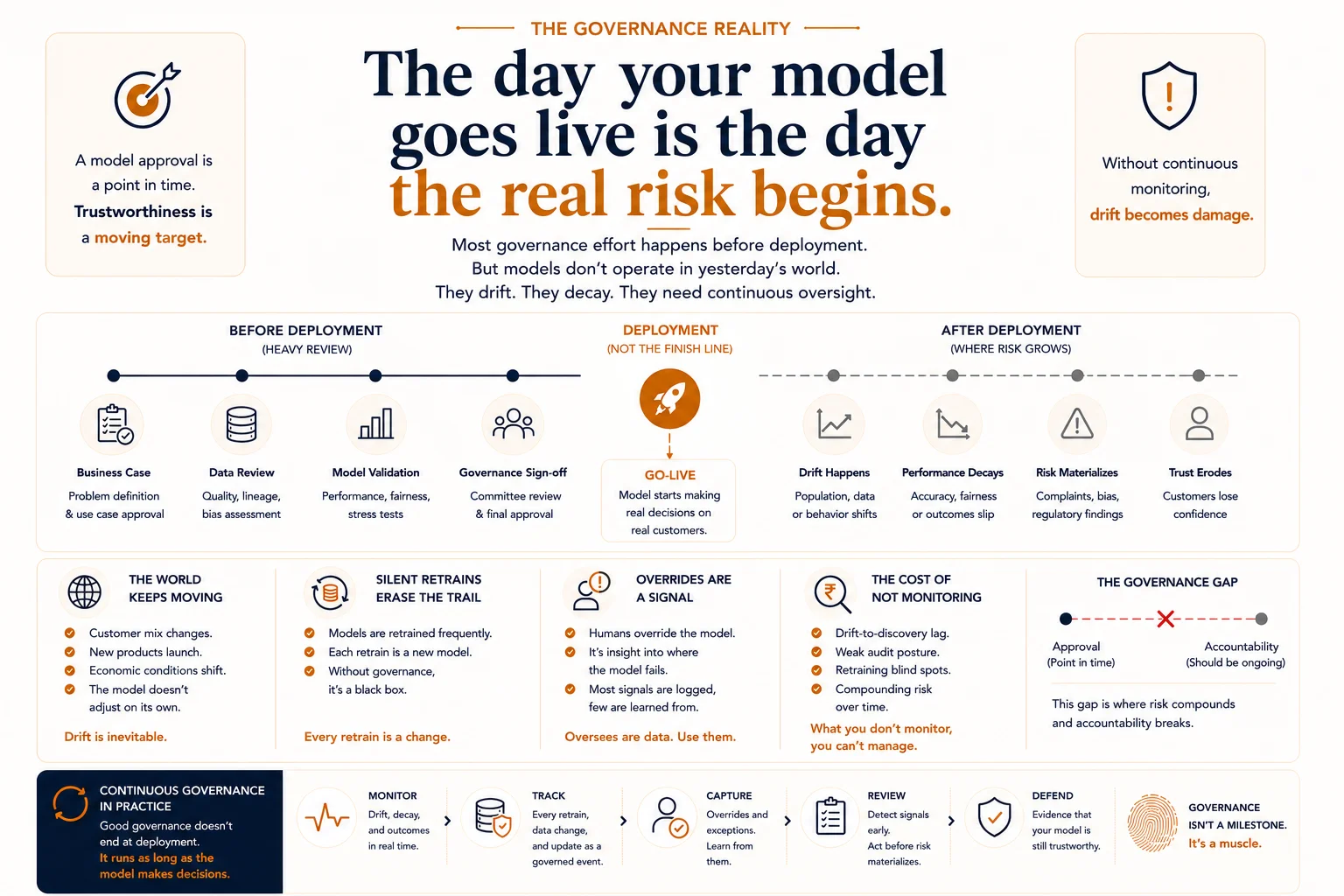
The Finish Line That Isn't
Here's something that keeps model risk teams up at night: the moment everyone treats as the finish line is actually the starting gun. A model goes through months of validation - fairness testing, documentation, sign-off from three committees - and the day it goes live, the review calendar goes quiet. The governance team moves on to the next model in the queue. The one that just shipped is now making real decisions, on real customers, with no one watching as closely as they were the week before.
And the longer a model runs unwatched, the further it can drift from the version that got approved. And the further it drifts, the less that original sign-off actually means. A fairness test from six months ago says nothing about a model that has since seen a shift in applicant demographics, a change in macroeconomic conditions, or a silent upstream data schema update. The approval was real. It just wasn't built to last.
Model governance is not a gate a model passes through once. It is a discipline that runs for as long as the model is making decisions.
First, Let's Be Clear About What We're Talking About
Post-deployment governance is not a once-a-year model review. It's not waiting for a complaint or an incident to trigger a look. And it's not the same checklist from validation, run again on a slower cadence.
Properly defined, it is the continuous set of practices that keep a live model accountable to the conditions it was approved under:
- Drift monitoring - tracking whether the input population, feature distributions, or outcomes have shifted from what was validated
- Performance decay tracking - watching whether accuracy, fairness, or business metrics degrade as real-world conditions change
- Change management - recording every retrain, parameter update, or upstream data change as a governed event, not a silent deploy
- Incident and override logging - capturing every time a human overrides the model, and why, as a signal worth reviewing
The failure mode is treating deployment sign-off as the deliverable, when the deliverable was always supposed to be an ongoing state of "still trustworthy," not a one-time verdict.
Why the Risk Actually Grows After Launch
The World Keeps Moving, the Model Doesn't. A credit model trained on last year's applicant pool doesn't automatically adjust when the pool shifts - a new product launch, a new customer segment, a change in acquisition channel. The model keeps scoring with old assumptions while the business quietly changes shape underneath it.
Silent Retrains Erase the Paper Trail. Many production models get quietly retrained on a schedule - weekly, monthly - often without a fresh governance review each time. Each retrain is a new model in every sense that matters, but it rarely gets treated as one.
Overrides Are a Signal Nobody Is Reading. When a loan officer overrides a model's recommendation, that override is data about where the model is failing in practice. Most institutions log the override for the individual case and never aggregate it into a pattern that should trigger a model review.
The Cost of Treating Deployment as the Finish Line
First, there's the drift-to-discovery lag. Without active monitoring, degraded model performance is typically discovered by a downstream symptom - a spike in complaints, a fair-lending question, a bad quarter - long after the underlying drift began. The gap between when a model started underperforming and when someone noticed is pure unpriced risk.
Second, there's the audit posture problem. An examiner who asks "how do you know this model still performs the way it did at approval" wants an answer backed by monitoring data, not a reference to a document signed a year ago. Institutions without post-deployment monitoring are relying on the sign-off date to do work it was never designed to do.
Third, there's the retraining blind spot. If a model has been silently retrained six times since approval and none of those retrains went through governance, the institution doesn't actually know which version of the model is running in production right now - only which version it approved once.
Closing Thought
The industry has gotten reasonably good at pre-deployment rigor: validation frameworks, fairness testing, sign-off workflows. That was necessary, and it is not sufficient. A model's risk profile is not fixed at approval - it is a function of the data, population, and conditions it encounters every day it stays in production, which means governance has to be a living process, not a one-time credential.
The institutions ahead of this aren't running more validation meetings. They're building the infrastructure to watch every live model continuously - drift, decay, retrains, overrides - so that "is this model still trustworthy" has a current answer instead of a stale one. That's the layer Anvax builds for BFSI institutions: governance that starts, not ends, the day a model goes live.