Sovereign Stack
RBI Is Serious About Democratising AI Compute
Here's something that keeps many regional bank and NBFC product leaders awake at night: their compliance teams can read the same RBI circulars as HDFC's, their engineers can attend the same webinars, and yet they still can't build the AI systems that larger institutions are building.
The problem isn't a lack of ideas or talent. It's infrastructure.
A production-grade GPU setup for something as demanding as fraud detection can cost more than some smaller financial institutions spend on their entire technology stack in a year.
That gap rarely appears in an audit. It becomes visible eighteen months later—when large private banks have already shipped multiple generations of AI-powered underwriting while a cooperative bank three towns away is still running the same rule engine it deployed in 2019.
RBI has recognised this problem. And this is one of the most important—and least discussed—parts of the FREE-AI Committee report.
A Report Being Read as Compliance. But It's More Than That.
Most discussion around the FREE-AI report, released on 13 August 2025, has focused on the governance elements: board-approved AI policies, audits, red-teaming, incident reporting, and accountability.
All of that matters.
But the infrastructure recommendations point to a different question:
What happens when smaller regulated entities don't even have the infrastructure required to build AI systems in the first place?
The Committee's answer is clear: they need shared infrastructure.
This is important because India's AI adoption gap isn't simply a training or talent problem. It's increasingly a balance-sheet problem.
A regional bank's technology team can be just as capable as a large private bank's.
Its GPU budget isn't.
What RBI's "Landing Zones" Actually Mean
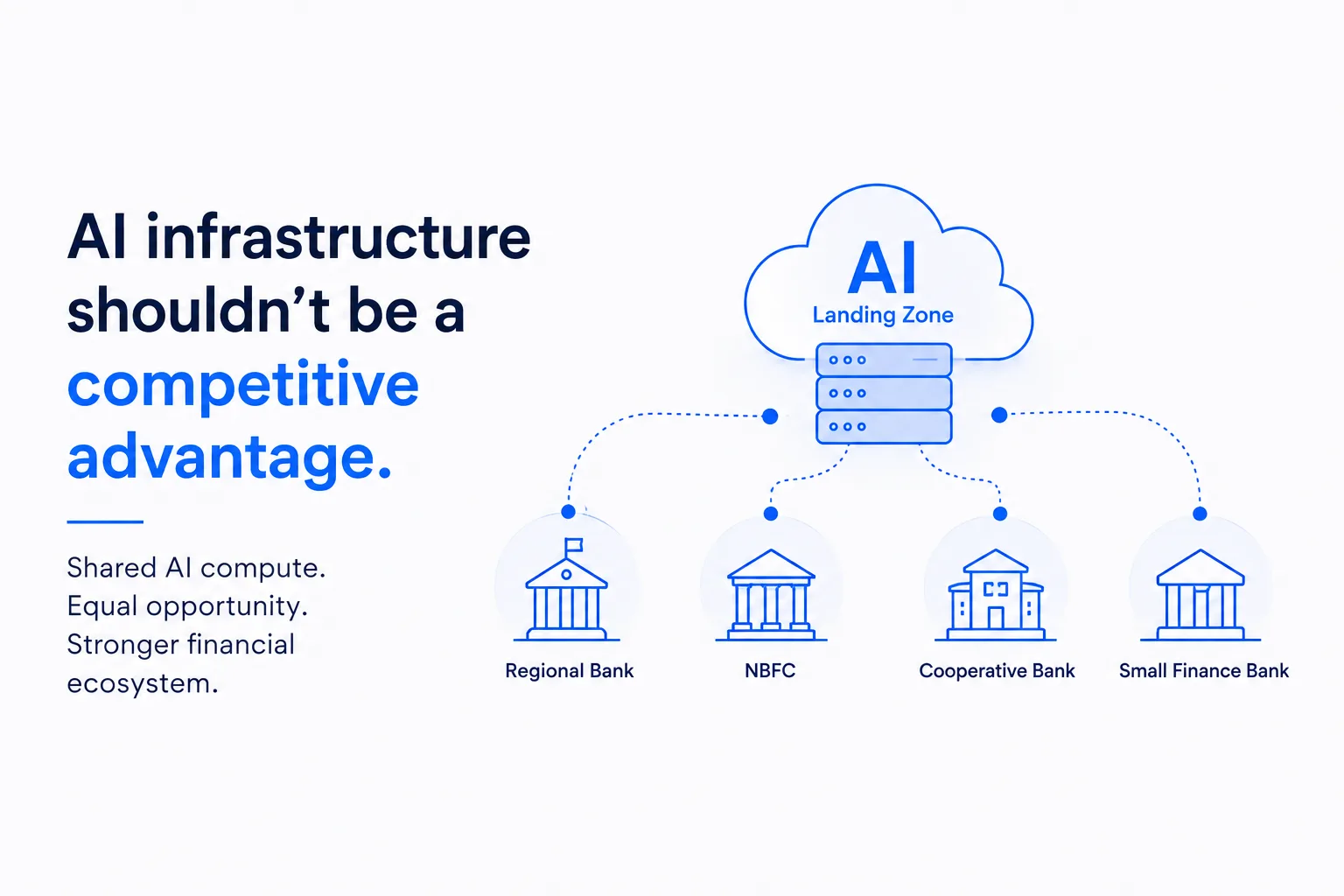
One of the most interesting proposals in the report is the creation of plug-and-play AI "landing zones".
The idea is relatively simple: provide shared AI compute infrastructure on a pay-per-use basis so smaller regulated entities can access the resources required to deploy AI without having to build their own expensive infrastructure.
The model draws from IFTAS, RBI's own IT subsidiary, which already operates shared cloud infrastructure for the financial sector.
The Committee suggests extending that approach to AI compute, potentially through RBI, NABARD, or the umbrella organisations that already support cooperative banks.
The initial infrastructure could leverage GPUs being made available through the IndiaAI Mission, which received ₹10,372 crore in the 2024 Union Budget and has expanded to roughly 38,000 GPUs, with access reportedly available at rates as low as ₹150 per hour for smaller developers.
That distinction matters.
RBI isn't necessarily proposing to build an entirely new compute ecosystem.
It's proposing to make existing national compute infrastructure accessible to institutions that otherwise couldn't afford it.
Imagine a mid-sized NBFC that has wanted to experiment with an LLM-powered document verification system for two years.
The team has the use case. It has the data. It has the people.
But every time the cloud infrastructure estimate comes back, the pilot gets pushed to the next quarter because the cost is larger than the available IT budget.
A landing zone doesn't make compute free.
It makes experimentation economically possible.
The Money Behind the Proposal
This isn't just a vague recommendation buried in a policy document.
The Committee proposes an initial ₹5,000 crore corpus for shared data and compute infrastructure, explicitly treating it as a public-good investment rather than a conventional return-generating investment.
Part of the proposed funding would support compute infrastructure, including capacity designed to remain relevant as technologies evolve.
Another portion would support AI labs through institutions such as the Reserve Bank Innovation Hub and academic institutions, helping develop the talent needed to actually use that infrastructure.
The Committee also proposes an additional ₹1,000 crore per year for five years, subject to annual review.
The precedent RBI points toward is particularly interesting: the Payment Infrastructure Development Fund (PIDF).
PIDF didn't ask every small merchant to build its own payment infrastructure. It helped make the infrastructure accessible enough for adoption to spread beyond India's largest cities.
FREE-AI appears to be applying a similar principle to AI compute.
Don't ask every institution to build its own GPU infrastructure.
Build shared rails that institutions can access.
Why This Matters Beyond Compute
The consequences of doing nothing aren't limited to technology budgets.
1. AI concentration becomes systemic risk
If meaningful AI capability ends up concentrated within a handful of large financial institutions, the AI risks RBI is trying to govern could become concentrated there as well.
That creates an interesting contradiction: a framework designed to promote responsible AI adoption could unintentionally reinforce the concentration of AI capability.
2. Financial inclusion could slow down
Some of the customers most likely to benefit from better AI-driven underwriting are precisely those who are harder to assess using traditional models:
- New-to-credit borrowers
- Thin-file customers
- First-generation MSME owners
- Smaller businesses with fragmented financial records
These customers are disproportionately served by smaller NBFCs, regional institutions, and cooperative banks.
If those institutions cannot afford the infrastructure required for modern AI systems, the benefits of AI could remain concentrated in the institutions serving customers who are already easier to underwrite.
3. Governance becomes theoretical
This may be the most important point.
A board-approved AI policy is useful only if the organisation is actually deploying AI.
An AI risk framework matters only when there are AI systems creating risk.
For institutions that cannot move beyond experimentation because infrastructure is unaffordable, the governance framework risks becoming theoretical.
You can't govern AI systems that you can't afford to build.
The Bigger Signal From RBI
Regulators publish governance frameworks all the time.
What makes this proposal different is that it combines three things:
A corpus.
A delivery mechanism.
An operational pathway.
RBI isn't simply saying, "Use AI responsibly."
It's asking a more fundamental question:
How do we make sure smaller financial institutions can participate in the AI economy at all?
That is a much bigger ambition.
Whether the proposed landing zones are implemented on schedule, whether the ₹5,000 crore corpus actually materialises, and whether a cooperative bank in a district far from India's technology hubs can eventually run a meaningful GPU workload are all still open questions.
But the direction is difficult to miss.
FREE-AI isn't only about creating rules for institutions that already have AI.
It's also about building the infrastructure required so that more institutions can get there.
That's the part of the report worth watching over the next year.
At Anvax, we're building the infrastructure layer around secure AI landing zones, audit trails, access controls, and model governance—so regulated institutions can make use of AI infrastructure without compromising control.
If your institution is thinking about what an AI landing zone could mean for its roadmap, the conversation probably needs to start before the infrastructure arrives - not after.