Sovereign Stack
What Happens to the Workflow When the Model Degrades
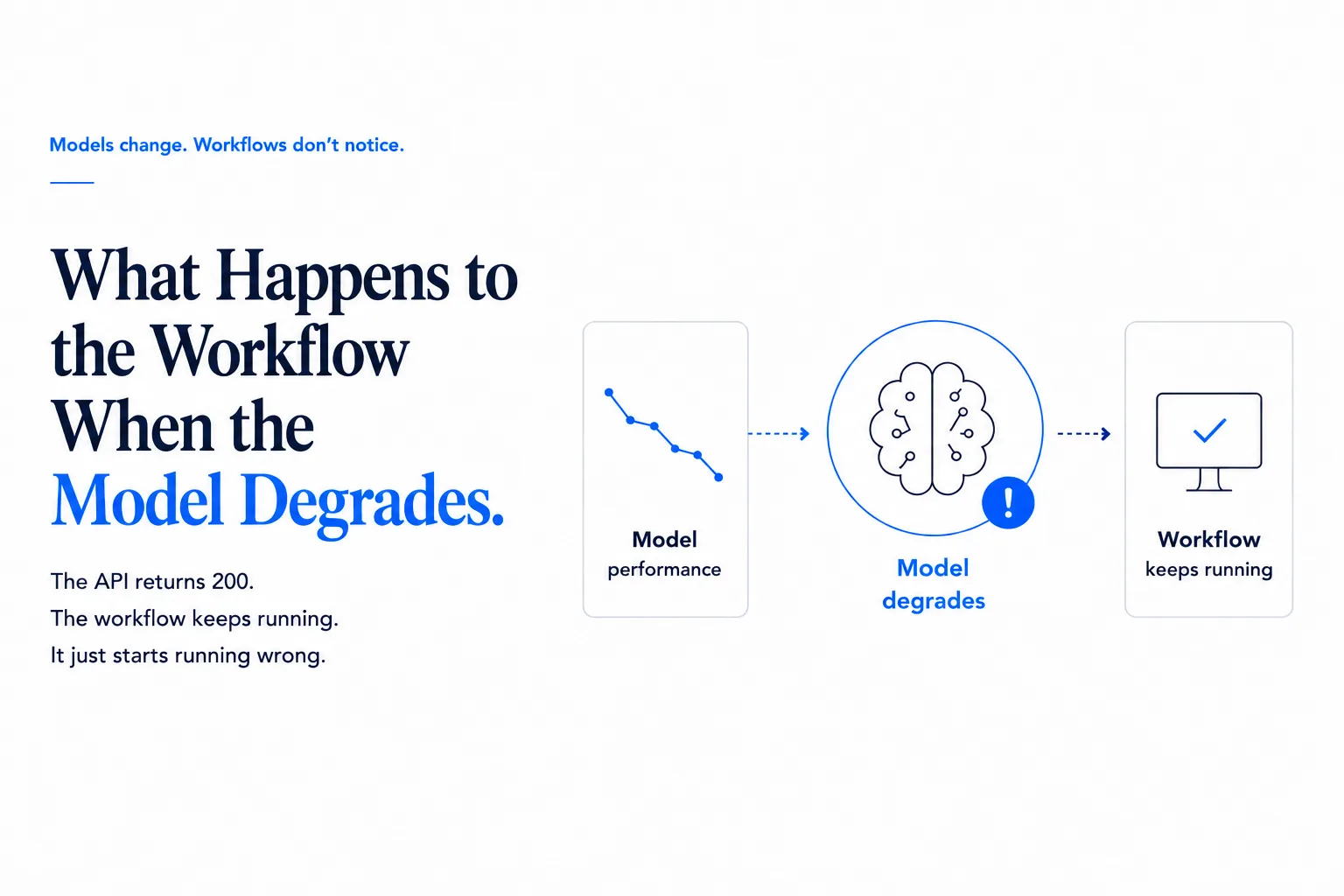
Model degradation is not a rare failure mode. It is a routine operating condition that most teams have not built a workflow for. A provider ships a silent update. A prompt that worked reliably for months starts hedging, hallucinating, or refusing. A fine-tune drifts as the underlying data distribution shifts. None of this shows up as a crash. The API returns 200. The workflow keeps running. It just starts running wrong. Model degradation is not a technical incident. It is an operational one, and most AI workflows in BFSI are not instrumented to notice it until a customer, an auditor, or a regulator does.
What "Degradation" Actually Means
Degradation is not the model going down. It's the model staying up while its outputs quietly stop being trustworthy. In a KYC document verification flow, that might mean the extraction step starts missing a field it used to catch reliably. In a collections chatbot, it might mean the model starts agreeing to payment terms it was never authorized to offer. In an underwriting assistant, it might mean the confidence language shifts, the same input now producing a softer or harder recommendation than it did a quarter ago, with no code change on your end.
None of these show up in uptime dashboards. Uptime is not the right frame. The right frame is drift: the gap between what the model does today and what it did when someone last validated it.
What Happens Downstream When Nobody Is Watching
Picture a mid-size NBFC running an AI agent to triage loan servicing calls. For four months, the model correctly routes escalations to human agents about 94% of the time. In month five, the underlying model gets a provider-side update. Nobody on the NBFC's side is told, because nobody asked to be told. The routing accuracy quietly drops. Calls that should have been escalated start getting closed by the bot with a generic response. Nobody notices for three weeks, because the workflow was built to trust the model's decision, not to sample and check it.
That's the failure. And it compounds. Each unescalated call becomes a customer who didn't get resolution. Each unresolved customer becomes a complaint. Each complaint becomes a pattern the compliance team has to explain after the fact, without a clean record of when the behavior actually changed.
That's the chain. It rarely announces itself.
The Gap Between Pilot Confidence and Production Reality
Most AI pilots are validated once, at launch, against a curated test set. Production is not a curated test set. Production is the full, messy distribution of real customers, real documents, real edge cases, running against a model that is not contractually guaranteed to stay the same. A pilot that clears validation in Q1 is not making any claim about Q3. Treating a one-time validation as a permanent guarantee is the single most common gap between pilot confidence and production reality in BFSI AI deployments.
What a Workflow Actually Needs When the Model Can Degrade
Continuous Sampling, Not One-Time Validation. A workflow built for a model that can degrade pulls a sample of live outputs on a schedule, human-reviews a subset, and tracks accuracy as a trend line, not a one-time checkbox. This is the same discipline banks already apply to fraud models. AI copilots and agents deserve the same treatment, not less.
A Rollback Path That Actually Works. If the current model version is underperforming a known-good baseline, the workflow needs a way to fall back, whether that's a previous model checkpoint, a stricter rules layer, or a lower autonomy mode that routes more to humans. Without a rollback path, degradation detection is just an alert nobody can act on.
Human Checkpoints Sized to Consequence. Not every step needs a human in the loop. The steps that touch money, consent, or a regulatory obligation do. When a model degrades, the workflow's blast radius should be proportional to how much autonomy that step was given in the first place. A degrading model with full autonomy on payment terms is a very different risk than a degrading model with full autonomy on FAQ suggestions.
An Audit Trail That Survives the Question "What Changed?" When a compliance officer has to reconstruct a specific customer interaction from three months ago, the workflow needs to be able to answer which model version handled it, what confidence it reported, and whether that version has since been flagged. Without version-stamped logs, "what changed" is a question nobody can actually answer, only guess at.
The Cost of Treating Degradation as Someone Else's Problem
First, the compliance cost. RBI and DPDP-adjacent obligations increasingly expect institutions to explain automated decisions, not just make them. An institution that cannot say when a model's behavior shifted cannot credibly answer that question.
Second, the customer trust cost. A customer who gets a wrong answer once forgives it. A customer who gets inconsistent answers across visits, because the model quietly changed underneath the product, starts to distrust the channel entirely. That distrust doesn't stay contained to one workflow. It spreads to the brand.
Third, the compounding operational cost. Degradation that goes undetected for weeks doesn't just produce bad outputs during that window. It produces a backlog of decisions that now need to be re-audited, a set of customers who now need to be re-contacted, and a leadership team that now has to explain a gap they didn't know existed. The longest-running failures are always the ones nobody was watching for.
Closing Thought
Every institution that has deployed a rules engine has a change-management process for it: version control, staged rollout, rollback plans. AI models need the same discipline, and most teams are still treating them like static software instead of the drifting, provider-controlled systems they actually are. The workflow doesn't need to assume the model is broken. It needs to assume the model can change without asking permission, and build the sampling, rollback, and audit muscle to catch that early rather than after a complaint forces the question.
At Anvax, this is the layer we build into every AI workflow we ship for BFSI clients: continuous output sampling, version-stamped audit trails, and rollback paths that are tested before they're needed, because governance that only exists at launch isn't governance. It's a memory of governance.