Sovereign Stack
What Happens When You Delete a Document From an AI System?
Someone in finance uploads a pricing memo to the shared drive by mistake. It was a draft, it names three customers, and it was never meant to leave the team. An hour later they delete it.
The next morning, a colleague asks the company AI assistant what pricing was agreed with one of those customers. The answer comes back, accurate and well-sourced, quoting a document that no longer exists.
Nobody did anything wrong. The file was deleted. The assistant was working exactly as designed.
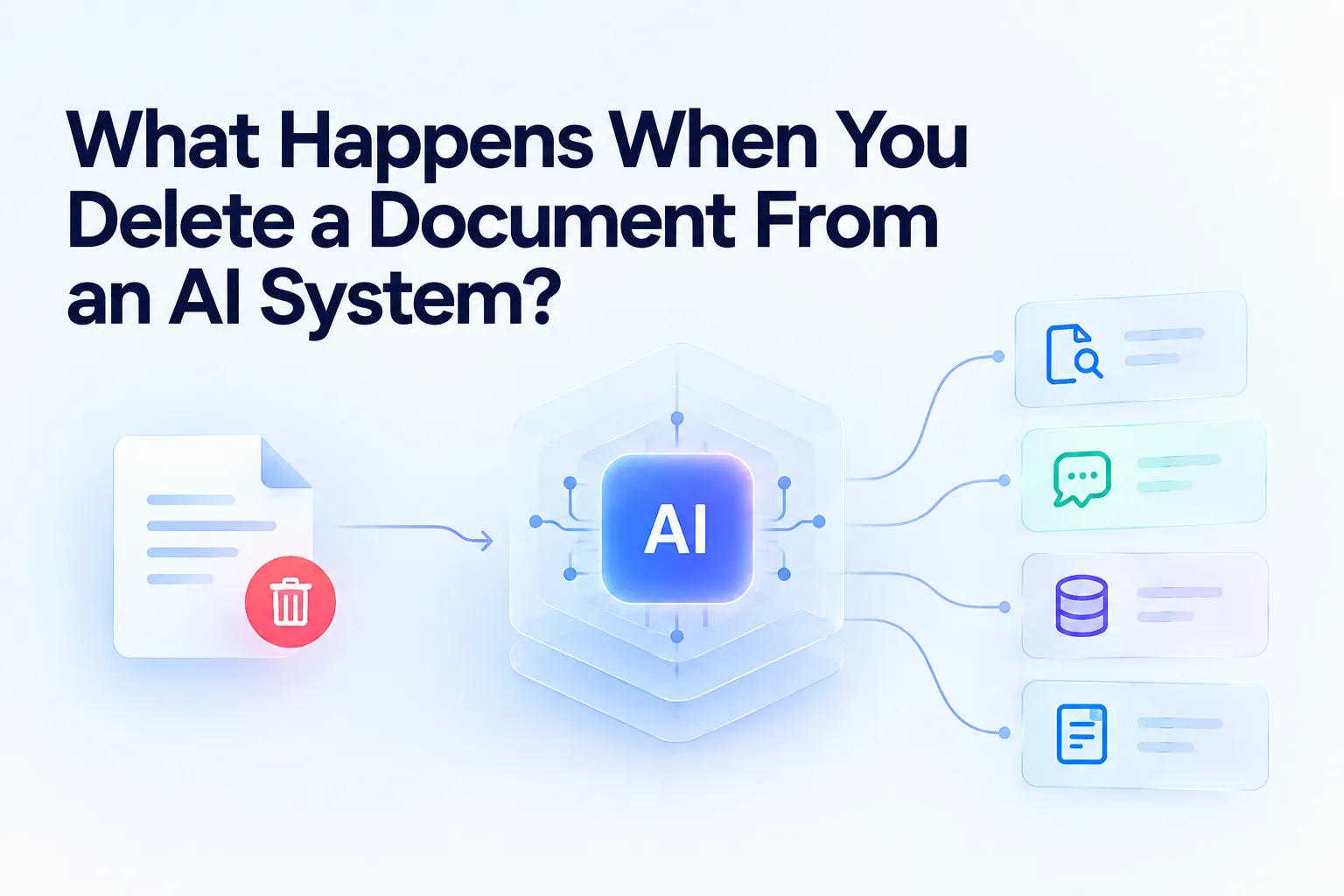
Deleting a document removes the file. It does not necessarily remove what the AI learned from it.
This is one of the least discussed properties of enterprise AI, and it becomes a practical problem the first time someone asks for information to be erased.
Why the Answer Outlives the File
To answer questions about internal documents, an AI platform does not read the shared drive at the moment you ask. That would be far too slow.
Instead it prepares in advance. A connector reads each document, splits it into smaller passages, and converts those passages into numerical representations that let the system find them later by meaning. The passages and their representations are stored in a search index, separate from the original file.
When someone asks a question, the platform searches that index, pulls the most relevant passages, and sends them to a model to compose an answer.
So the index is not a shortcut to your documents. It is a copy of their contents, held somewhere else, in a different shape.
Delete the original file and the index copy is untouched, unless something tells it to go.
Deletion Has to Travel, and It Often Does Not
Most connectors are good at noticing new and changed documents. Deletions are harder.
A new file announces itself. A deleted file simply stops being there, and the connector has to notice an absence rather than an event. Some platforms handle this well, using the source system's change feed, which reports deletions explicitly. Others compare the full document list on each sync and remove whatever has gone, which only works as often as that full sync runs. On a large repository, a full sync can be a weekly job.
This produces a gap between the moment of deletion and the moment the content stops being retrievable. During that window, the system will keep answering from it.
The gap is worth measuring rather than assuming. It is the difference between "we deleted it" and "it can no longer be surfaced", and only one of those is a statement you can make to a customer or a regulator.
The Copies That Deletion Usually Misses
Even when the index is cleaned correctly, content from a document can survive in several other places.
Cached answers. Many platforms cache responses to repeated questions to save cost and latency. If the cache is keyed only on the text of the question, an answer generated from the deleted document can continue to be served, and it will not appear in any index search.
Saved outputs. Summaries, briefing notes, meeting recaps and generated reports that the system produced earlier are new documents in their own right. They contain the content, they are often stored back into the same workspace, and they are not covered by deleting the source.
Logs and traces. Diagnostic logs frequently capture the prompt sent to the model, which includes the retrieved passages. A log retained for ninety days holds those passages for ninety days.
Backups and snapshots. The index has backups, like any other datastore. A restore after deletion can quietly bring removed content back if the deletion queue does not replay.
Evaluation sets. If passages were copied into a test set to measure answer quality, that set is another copy, usually outside the main system entirely.
A deletion that only removes the source file leaves at least four copies of its content behind.
What Deletion Should Actually Do
A system that handles this properly treats deletion as an event that propagates, not as a file disappearing.
When a document is deleted in the source system, the platform should receive that as a signal rather than discovering it on the next full sync. That signal should trigger removal of every passage belonging to that document, and every stored representation of those passages, identified by a stable document ID that ties the pieces together.
The same ID should reach everything derived from the document. Cached answers need to record which documents they drew on so they can be invalidated. Generated summaries need to be traceable to their sources, so at minimum someone can be told which saved outputs contain material from a deleted document.
Finally, deletion should leave a record. Not the content, but the fact: this document was removed, at this time, from these stores. That record is what lets you answer the question "can you confirm it is gone" without re-reading anything sensitive.
Where the Legal Side Comes In
For personal data, this stops being a design preference.
Data protection frameworks give individuals rights over their personal data, including the right to have it erased in defined circumstances. Organizations operating onshore in the UAE, in the DIFC, in ADGM, in the EU and in many other jurisdictions all work under some version of this, with different conditions and exemptions.
What matters architecturally is the same everywhere. If someone exercises a right to erasure and the organization deletes the record from the source system but leaves the content retrievable through the AI assistant, the erasure is incomplete in practice, whatever the ticket says.
This is also why "we can delete it from the index" is only half an answer. The question is whether deletion reaches the derived copies, and whether anyone can demonstrate that it did.
Exactly which obligations apply, and what counts as sufficient, depends on the applicable framework and the circumstances. The engineering requirement is to make the system capable of complying rather than to assume it already does.
What To Ask, and How To Test It
Six questions tend to settle how a platform handles this.
- Signal - Does the platform learn about deletions from the source system's change feed, or only on a full sync? How often does that sync run?
- Propagation - When a document is deleted, what is removed: the passages, the stored representations, both, and in what time frame?
- Caches - Are cached answers tied to their source documents, so they can be invalidated when one is deleted?
- Derived content - Can the platform identify which saved summaries or reports drew on a given document?
- Logs - Do logs contain retrieved passages, how long are they kept, and are they in scope for a deletion request?
- Evidence - After a deletion, can the platform show a record of what was removed and from where?
Then run the test, because it takes about a day and answers all six at once.
Pick a document that is the only source for a specific fact. Confirm the assistant can answer that question. Delete the document in the source system. Ask again immediately, then after an hour, then the next day. Ask twice using different wording, since identical phrasing may be served from a cache. Then check whether any saved summaries still contain the content.
The point at which the system stops answering is your real deletion window. Everything still holding the content after that is a copy nobody was tracking.
Where Anvax Fits
Anvax treats a document's identity as something that persists through the whole system, so that a deletion can be followed everywhere the content went: the passages, their representations, the cached answers that used them, and the record of what was removed.
Our view is that deletion is an operational guarantee, not a cleanup task. An enterprise should be able to delete a document, state when it stopped being retrievable, and show the evidence for that claim.
Before anyone promises a customer that something has been erased, it is worth knowing how long your own system keeps answering from it.
Because in an AI system, deleting the file is the easy part. Deleting what the file became is the actual work.
Team Anvax writes about enterprise AI governance, audit, and self-hosted deployment for regulated industries. — About Anvax