Sovereign Stack
What Does "In-Country AI" Actually Mean in the UAE?
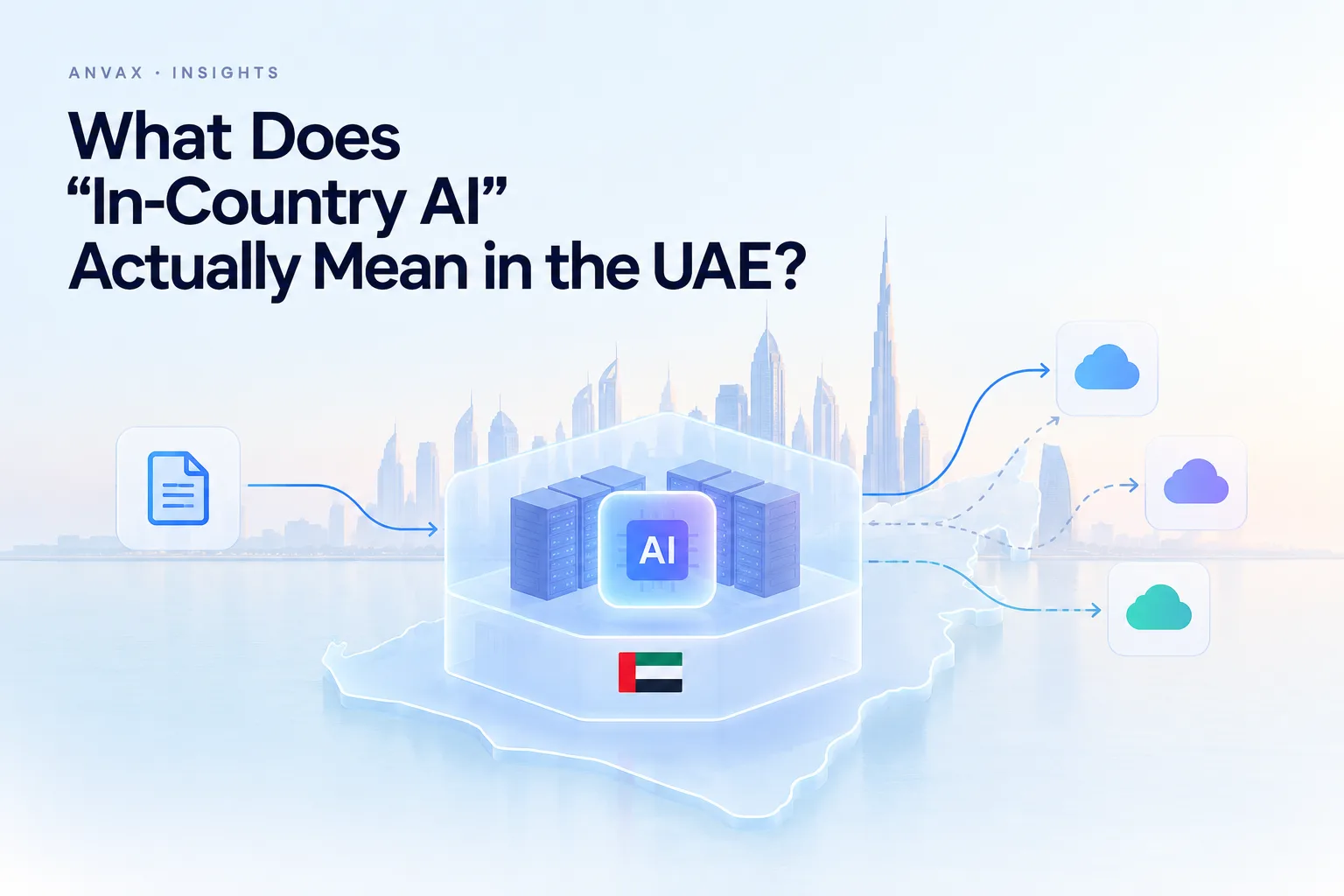
A vendor tells you its AI platform is hosted in the UAE. You ask where your data is stored, and they point to a cloud region in Dubai or Abu Dhabi.
That sounds reassuring. But it doesn't tell you where your data goes when someone actually uses the AI.
Imagine an employee uploads an insurance policy and asks the AI to summarize its exclusions. The document is stored in the UAE. But what happens when the platform converts it into searchable vectors? Where does the question go when the employee submits it? Where are the relevant passages processed? Where do the logs end up? And what happens when the vendor's support engineer needs to investigate a problem?
These are not separate edge cases. They are all part of the same request.
Your AI can be hosted in the UAE without every part of its operation staying there.
For organizations handling customer records, financial information, internal policies or commercially sensitive documents, that distinction matters.
Start With the Entire Request, Not the Cloud Region
Most AI platforms are built from several services working together. A document store might sit in one region, an embedding service might be operated elsewhere, and the language model might run on a separate provider's infrastructure. Logging and support tools can introduce further dependencies.
The result is that the location of the application tells you very little about the complete journey of your data.
Consider what happens when an employee asks a question about an internal document.
First, the platform searches its knowledge base for relevant information. That knowledge base was probably created by processing documents through an embedding model. Then the platform sends the question and relevant passages to a language model to generate an answer. Along the way, the system may produce logs, traces and diagnostic information.
If any of these services operate outside the UAE, data may cross the border even though the main application and database remain in-country.
This is why residency should be evaluated across the entire architecture, not inferred from a hosting location.
The Data May Leave Before Anyone Asks a Question
Indexing is an easy part of an AI architecture to overlook.
Before a document can be retrieved by meaning rather than just keywords, it is usually divided into smaller passages and converted into numerical representations called embeddings. Those embeddings help the system find relevant information when someone asks a question later.
If a hosted embedding service processes the document, its contents may be sent to that service during ingestion. The same can happen when documents are updated or indexed again.
This creates a problem that a live product demonstration won't necessarily reveal. The documents may already have been indexed before the demonstration begins.
For a business connecting thousands of internal documents, indexing deserves the same scrutiny as the model answering the questions. Ask where the embedding model runs, what information it receives, and whether document processing depends on an external service.
The Bigger Question Is Where Inference Happens
Now consider the employee's question.
In a retrieval-augmented generation (RAG) system, the AI typically receives more than the question itself. It also receives relevant passages retrieved from the organization's documents, along with instructions and other context needed to generate an answer.
That context might contain customer details, internal procedures, claims information or confidential business decisions.
If inference happens outside the UAE, those passages may be transmitted to the external model service for processing. The original documents do not have to move for their contents to leave the country.
There is another detail worth checking: whether the model is actually pinned to in-country infrastructure.
A provider may offer a model through a UAE-region endpoint while retaining routing arrangements that allow requests to be processed elsewhere. Some architectures also send difficult questions to a larger model while handling simpler ones locally.
The question is not whether a model is available in the UAE. It is whether your deployment guarantees the processing location you require, including how routing and fallback behavior work.
Logs and Support Are Part of the Picture Too
Even when document processing and inference happen locally, operational data can follow a different path.
AI platforms generate logs to help teams understand failures, investigate incidents and monitor performance. Depending on how the system is configured, these logs may include prompts, model responses, document references or snippets of sensitive content.
If those logs are forwarded to a vendor's monitoring service outside the UAE, the deployment has another data flow to account for.
The same applies to support.
When a vendor investigates a problem, engineers may request diagnostic bundles, inspect traces or use remote access tools. A screenshot or an error report can contain more sensitive information than it appears to at first glance.
This does not mean every external log or support interaction necessarily violates a residency requirement. It means these flows need to be understood, documented and assessed against the organization's applicable legal, contractual and security obligations.
Ask where operational data is sent, what it contains, who can access it and how support works when customer content cannot leave the environment.
The UAE Does Not Have One Universal Compliance Answer
Technical architecture is only half the conversation. The other half is understanding which legal and regulatory requirements apply to the organization.
For example, businesses operating onshore may fall within the scope of the UAE's Federal Decree-Law No. 45 of 2021 on the Protection of Personal Data. Organizations established in the Dubai International Financial Centre or Abu Dhabi Global Market may instead be subject to their respective data protection frameworks, alongside any other applicable requirements.
Sector-specific obligations, government procurement conditions and internal data-classification policies can introduce additional restrictions.
These are not interchangeable regimes, and data residency should not be treated as a substitute for legal compliance. Whether information can be transferred, under what conditions, and which safeguards are necessary depends on the applicable framework and circumstances.
For an AI buyer, the practical starting point is simple: establish which rules apply, identify the data involved, and make sure the vendor's commitments address the actual deployment rather than offering a generic statement about UAE hosting.
What Should You Ask a Vendor?
You do not need to begin with a 100-question security questionnaire. Start with a few questions that reveal how the system actually works.
- Storage - Where are the primary data, backups, replicas and indexes held?
- Indexing - Does document ingestion call an external embedding service, and where does that processing happen?
- Inference - Where is the model running, and can requests be routed outside the approved environment?
- Logs - Where are prompts, responses, traces and error reports stored, and do they contain document content?
- Support - Can the vendor diagnose problems without exporting customer content or establishing an outbound connection?
- Evidence - Can the vendor demonstrate these boundaries in the deployed system and document the commitments contractually?
The last question is particularly important. Architecture diagrams describe how a system is intended to work. Configuration, network traffic and operational procedures help establish how it actually works.
Where the deployment permits it, test both document ingestion and a live query. Observe the outbound connections, identify the services receiving data, and compare the results with the vendor's architecture documentation. Review the logs and support arrangements as well, since a network trace alone will not establish every access or processing path.
The goal is not to assume that every external service is unsafe. It is to replace assumptions with evidence.
In-Country AI Has Trade-Offs
Keeping the entire AI workload inside an organization's environment can offer greater control over data flows, but it is not a free upgrade.
The choice of models may be narrower, particularly if the organization requires dedicated local compute. GPU capacity, peak demand and response times need to be planned. Updates, monitoring and incident response also require an operating model that works within the agreed boundaries.
Support can be more involved when external access is restricted. Teams may need local diagnostics, carefully redacted support bundles and a defined approval process for any exceptional access.
These are engineering and operational decisions, not reasons to abandon in-country deployment. They should simply be understood before the system goes into production.
The right architecture depends on the organization's requirements. Some businesses can use regional managed services with appropriate safeguards. Others need a much stricter boundary around their data and processing.
What matters is that the choice is deliberate, and that the vendor's claims match the architecture being delivered.
Where Anvax Fits
Anvax is built around the idea that enterprises should be able to use AI with their internal knowledge and workflows without giving up control of their environment.
For organizations that require local processing, that means looking beyond where the application is hosted. Document ingestion, embeddings, retrieval, inference, logs and operational access all need to be considered together.
Our approach is to run these components within the customer's environment, rather than depend on an external service to process document content or generate answers. The objective is to make the data boundary an architectural decision, not simply a statement in a hosting description.
For UAE organizations evaluating AI, the conversation should begin with a more useful question than "Where is your platform hosted?"
Ask what happens to your data from the moment it enters the system to the moment the answer is delivered, and how you can verify it.
Because in-country AI is not just about where your data lives. It is about where your AI works.
Team Anvax writes about enterprise AI governance, audit, and self-hosted deployment for regulated industries. — About Anvax